
Maximum Damage, Minimum Cost
On February 27, 1776...

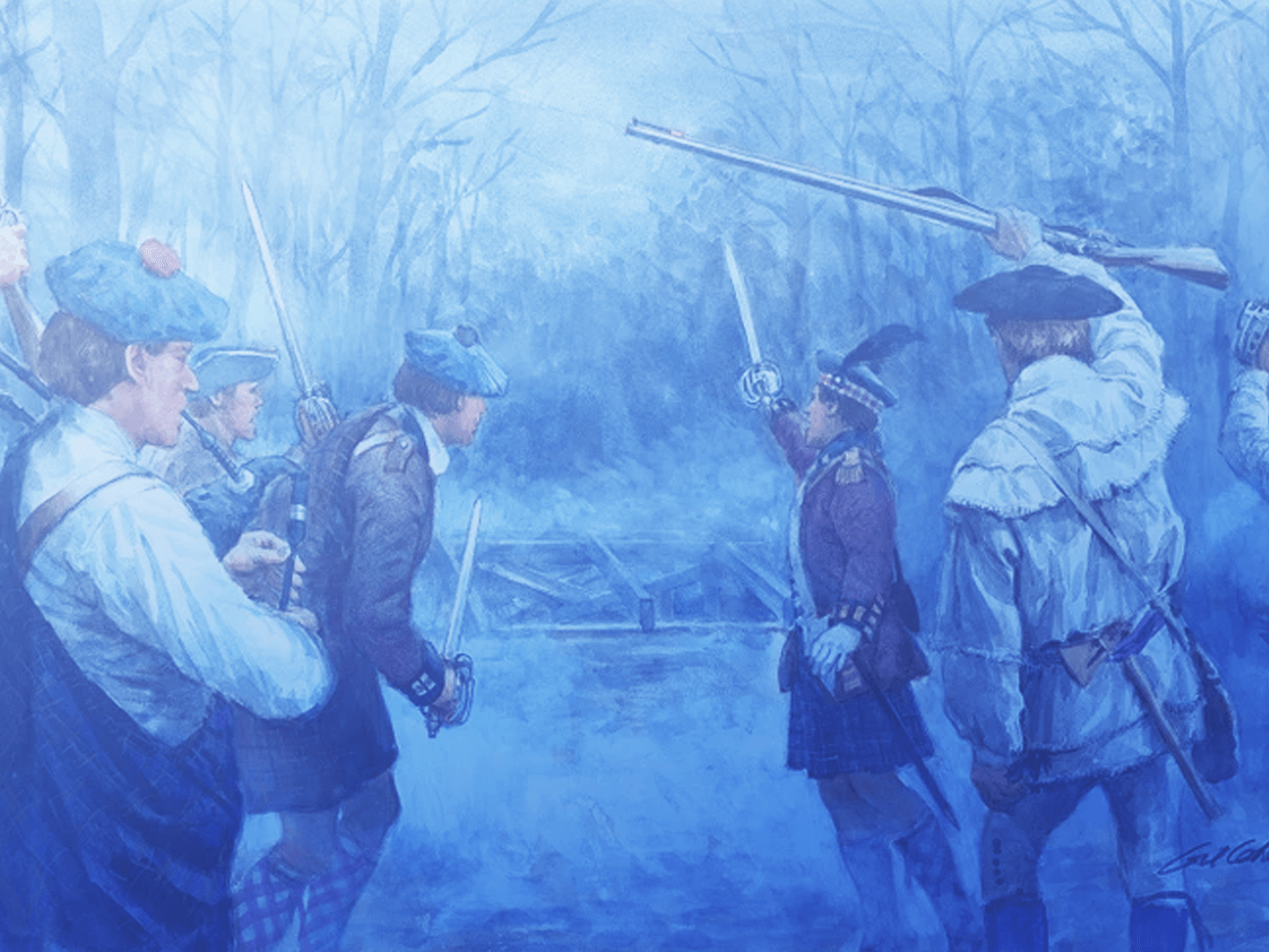
When Scottish Highlanders first had to face English muskets and cannons in the 1600s, they devised a new battle tactic that came to be known as the “Highland Charge.” It was a version of shock and awe. Knowing that their limited firearms and their swords and knives were no match against better-armed English troops, the Scots chose their most fearsome warriors to run downhill in a wedge directly into the enemy’s fire. The frontline Scots would fire their own weapons, crouch to avoid the return volley, but then charge directly into the enemy’s line before they could reload. If it worked, the enemy’s superior weapons would be overwhelmed by the sheer force of the charge. Mayhem ensued.
By 1776, veterans of the Anglo-Scottish border wars understood the tactic well and had brought their knowledge to America. The British Army quickly realized it had an asset to use against the rebellious colonialists and set out to recruit a regiment of retired Scottish soldiers, the Royal Highland Emigrants. One of the battalions of this regiment was stationed in North Carolina. It was there on February 27, 1776, when the Loyalist militia in North Carolina, consisting of 600 Highland Scots and about 100 other men, attempted a Highland Charge against the Revolutionary militia entrenched at Moore’s Creek Bridge, 18 miles north of Wilmington. It was a small, one-sided battle lasting all of three minutes. The Loyalists were soundly defeated, and two of their leaders were among the dead. But the skirmish entered history as the last time any military force attempted a Highland Charge. The Revolutionary militia planted nine musket balls and more than 20 “swan shots” in Lieutenant-Colonel MacLeod, who led the charge. The Loyalists left about 50 dead. The Revolutionaries had one killed and one wounded. In the days that followed, the Revolutionaries captured some 850 Loyalist militia members.
It was a small military victory for the Americans, but it had outsized results. For the next four years, North Carolina was safe from both the Loyalists and the British. The Loyalists found it impossible to recruit new troops in significant numbers.
The logistics of the battle present a few interesting points. The Loyalists, under a flag of truce, had approached the Patriots with a demand for surrender, but their real purpose was to reconnoiter the Revolutionaries’ position. The Loyalist laid their plans on that information, but during the night, the Patriot commander, Colonel James Moore, moved his men to the opposite side of the creek, dismantled the bridge’s blanks, and greased the rails. When the Loyalist leader MacLeod approached the bridge, he called out in Gaelic, and when no one answered, he ordered his ill-fated charge.
A Patriot described the Loyalists approaching the bridge as “banner and plums waving in the breeze, and all marching in good order but with a quick step.” Moments later, under American rifle fire backed with two artillery pieces, “Old Mother Covington” and “Her Daughter,” the Loyalist forces were slaughtered. In the words of historian Rick Atkinson, many “dragged under by their heavy kilts, the bodies drifted on the current like tartan water lilies.”
One lesson for us today is that the Highland Charge isn’t an especially good tactic against a well-armed and tricky adversary. Perhaps that’s why our military is mixing things up. It dropped 14 “bunker buster” GBU-57A/B MOP bombs from B-2 Stealth planes on Iranian nuclear sites on June 22, 2025. It grabbed Venezuelan dictator Nicolas Maduro from his bed at around 2:00 a.m. on January 3 and whisked him off to the USS Iwo Jima. It blows up fast drug boats in the Caribbean and the Pacific, sinking 45 so far, and killing 151 of the aqueous drug runners. It has seized a hefty portion of the much slower “ghost fleet” of Russian oil tankers on the high seas.
Colonel James Moore would be proud. We are carrying on his legacy of maximum damage to the enemy at minimum cost in U.S. casualties. Look on the tartan water lilies and reflect.
Follow the National Association of Scholars on X.
Art by Beck & Stone
Peter, so interesting you brought old military truths learnd right up to the present. Yes, America showing many ways to attack. With Iran, I worry most about all of their short range nukes and our nearby bases. But so true. Attack by bombers. Attack by special forces to extract. This is on of the important things of the administration. Doing new things in attacking enemies. Not from a Highland Charge. But showing different ways of American offense and defense.