
The First Principle
On June 12, 1776...

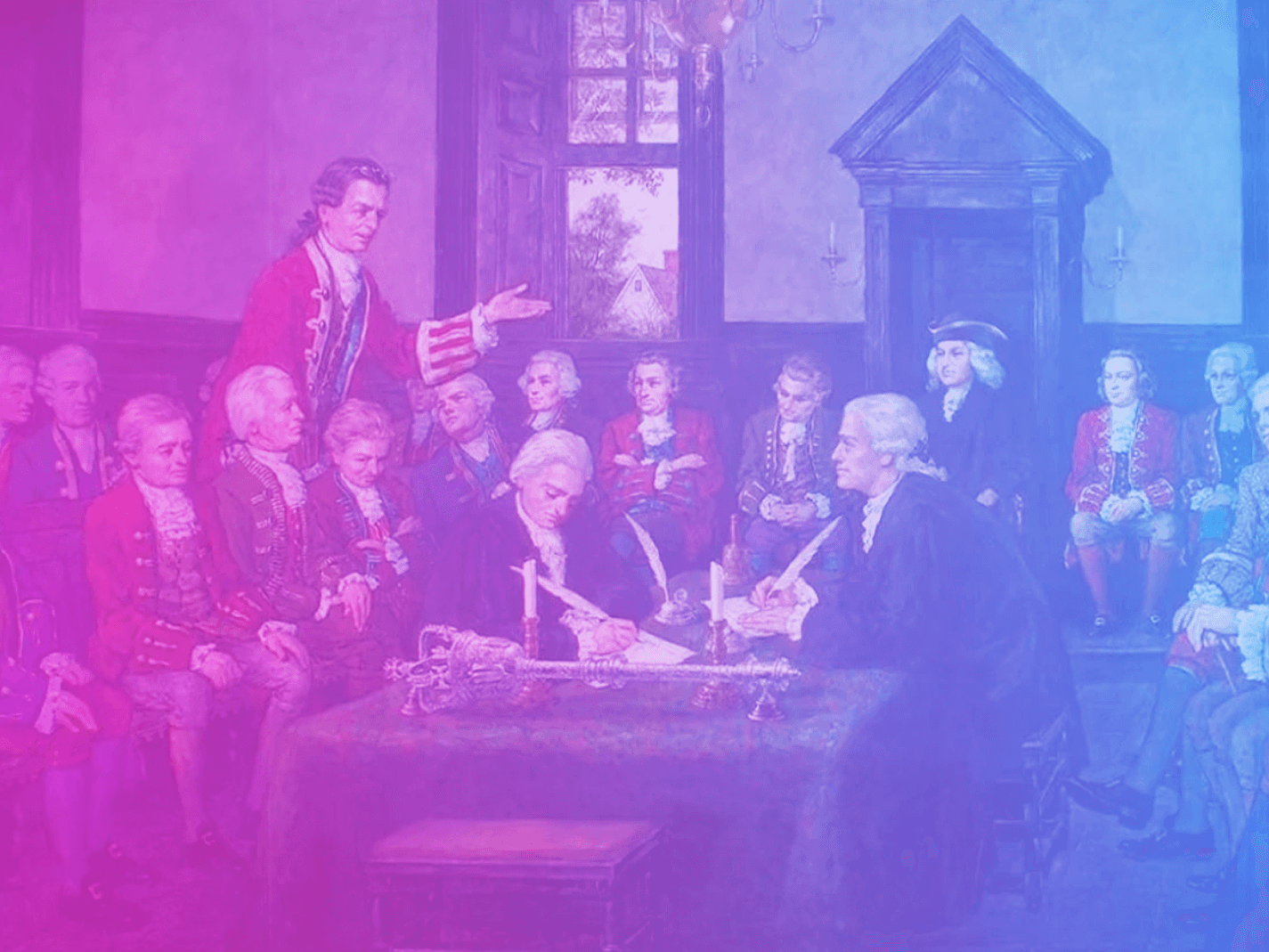
It was May 1776, and things were hopping in Virginia. The Old Dominion was the oldest, largest, and most prosperous of the British Colonies. It was the political center of America, with something like an aristocracy as well as a prosperous farmer and merchant class. True, Boston was the cradle of the Revolution. But Bostonians were men of less toughness than tongue; it’s good they had a Virginian to save their city from British occupation. Tom Paine first tried out his revolutionary ideas in Philadelphia in January, but by May they had swept Virginia too.
Other colonies had enacted constitutions, of a sort (see North Hampshire’s skimpy example) or tip-toed towards independence (see North Carolina’s conditional resolves or Rhode Island’s legal legerdemain). Now it was time for Virginia to show the others how it’s done. In April 1776, candidates stiffly vied for election to the Fifth Virginia Convention, which convened in Williamsburg on May 5. On May 15, the Convention resolved that its representatives to the Continental Congress, Thomas Jefferson and Richard Henry Lee, should vote, without any conditions, for American independence. At the same time, the Convention resolved to fashion a Declaration of Rights and Constitution for their new state.
28 delegates—over one-fifth of the entire Convention—crowded onto the Committee to craft the Declaration. Then George Mason—at age 50 a senior member of the Convention, the “Virginia Planter” famous for his protest of the Stamp Act of 1765, primary author of the Fairfax Resolves of 1774 against the Intolerable Acts, who missed the first two weeks of the Committee’s gas-bagging due to poor health—arrived at Williamsburg and unveiled a draft Declaration of Rights that “swallowed up” all other contenders. The Convention approved the Virginia Declaration of Rights on June 12, 1776.
As delegate Edmund Randolph put it 30 years later:
To this work [the formation of a constitution or government], then unprecedented in America, talents were requisite of a higher order, than those, which could foment a revolution. Patriotism, firmness and a just foresight of the dangers to be encountered, were sufficient to dissolve an empire. But the deepest research which had then been made here into the theory of government, seemed too short for those scenes, which the new order of things was to unfold, and for those evils, which human passions, with new opportunities and solicitations must beget.
Insofar as people today know of the Virginia Declaration of Rights, they likely view it in the light of James Madison’s masterpiece of 1789, the United States Bill of Rights. In comparison, the Virginia Declaration may look rather baggy, as it speaks of much more than individual rights. How then to make sense of Randolph’s praise?
The final version of the Virginia Declaration of Rights consists of 16 sections. Basing his work on Magna Charta and the English Declaration of Rights of 1689, Mason’s draft included 14 of the final articles, while Patrick Henry added a 15th, and Madison added the 16th.
These sections fall into three main parts: First, Sections One and Two lay out the “fundamental principles” of natural rights and popular power. Next, Sections Three to Eleven outline governmental arrangements to preserve liberty. Finally, Sections Twelve to Sixteen sketch social practices—which government ought not to interfere with—to protect freedom.
The Declaration—and how republican is the word “Declaration,” with its French and Latin overtones; Princes command, Citizens declare; a declaration is everyone’s property, a shared or common good, a res publica—begins with this rousing statement (Section One):
That all men are by nature equally free and independent and have certain inherent rights, of which, when they enter into a state of society, they cannot, by any compact, deprive or divest their posterity; namely, the enjoyment of life and liberty, with the means of acquiring and possessing property, and pursuing and obtaining happiness and safety.
Nature, not a Creator, is the ground of rights. These rights are individual, not collective. By nature, human beings are independent of one another. Nothing could be more different from the classical principle that “Man is by nature a political animal.”
The claim that “all men are by nature equally free and independent” caused a stir among slave-owning delegates. Compromise was reached by claiming that slaves were not “constituent members” of their society. The Declaration thus enshrined the view that the slave stands outside the state of society, or, in other words, that slavery is not a social relation but one of violence—a powerful admission. People today wonder how a bunch of white guys ended slavery; they started by undermining it in just this sort of way.
Section Two is also fundamental: “all power is vested in, and consequently derived from, the people.” The connecting link from Section One to Two is that, by himself, man is weak, and so his individual rights are threatened by other men. Together, “the people” are strong.
But this strength is a double-edged sword. Hence, Sections Three to Eleven outline governmental securities to individual rights. Section Three underscores that “government is, or ought to be, instituted for the common benefit, protection, and security of the people, nation, or community.” The ideal government is republican, not factional. Thus, Section Four introduces the first “ought not”: “That no man, or set of men, is entitled to exclusive or separate emoluments or privileges from the community, but in consideration of public services.” This “explodes,” as Randolph put it, inheritance in office. The same principle would also explode privileges in vogue today, such as “diversity, equity, and inclusion.”
Section Five separates the legislative, executive, and judicial powers, and sets the expectation that members of the legislature and executive should be returned frequently to “private station.” Section Six affirms the people’s powers over their magistrates through the “right of suffrage,” which belongs to “all men, having sufficient evidence of permanent common interest with, and attachment to, the community.” So much for migrants and out-of-state college students voting.
Sections Eight to Eleven enumerate the judicial protections to individual rights: the right in criminal cases to have a trial, face accusers, and hear evidence; the prohibition of excessive bails, fines, or cruel and unusual punishments; a prohibition on general warrants; and the sanctity of trial by jury in civil cases involving property.
Finally, Sections Twelve to Sixteen lay out what one might call social or extra-governmental protections to individual rights. Section Twelve calls “freedom of the press” “one of the great bulwarks of liberty.” Section Thirteen declares that “a well-regulated militia”—not a standing army or professional fighting force, but one “composed of the body of the people, trained to arms”—“is the proper, natural, and safe defense of a free state.” Section Fourteen calls for uniform government within the state. (No CHAZ or CHOP or Antifa checkpoints.)
As an aside, one can appreciate the Declaration’s brilliance in its placement of Section 13—the militia. Why is it here, among these social bulwarks to liberty? An army defends a free state from external enemies, but it can be used for despotism, too. That is exactly why Mason speaks of the militia, “composed of the body of the people,” i.e., all of us, trained in arms. Would such a militia deter war? Perhaps. It certainly deters tyrants. It is the ultimate “common sense gun control.”
Section Fifteen, Henry’s addition, states, “That no free government, or the blessings of liberty, can be preserved to any people but by a firm adherence to justice, moderation, temperance, frugality, and virtue and by frequent recurrence to fundamental principles.” And Section Sixteen, from Madison’s pen, concludes,
That religion, or the duty which we owe to our Creator, and the manner of discharging it, can be directed only by reason and conviction, not by force or violence; and therefore all men are equally entitled to the free exercise of religion, according to the dictates of conscience; and that it is the mutual duty of all to practice Christian forbearance, love, and charity toward each other.
Each person has a right of conscience, a right to believe as they wish about God and religion. But you have a duty to act towards others in a Christian manner. You don’t have to be a Christian or profess the Christian faith, but you must act in a Christian manner. Church and State each fortify the other.
The Declaration thus forms a beautiful arc, from Nature to the Creator, from fundamental rights to virtue and piety.
One could unpack much more in this well-wrought Declaration. But on the subject of education, let’s consider the admonition for “frequent recurrence to fundamental principles” (Section Fifteen). On September 3, 2025, before the United States Senate Foreign Relations Committee, a nominee for Assistant Secretary of State quoted his future boss, Secretary Rubio, saying, “We are a nation founded on a powerful principle, and that powerful principle is that all men are created equal, because our rights come from God our Creator—not from our laws, not from our governments.”
Tim Kaine, Senator from Virginia no less, then objected, “I find that very, very troubling.” He went on, “The notion that rights do not come from laws and do not come from the government, but come from the Creator, that is what the Iranian government believes.” As he explained, “I am a strong believer in natural rights, but I have a feeling if we were to have a debate about natural rights in the room and put people around the table with different religious traditions, there would be some significant differences in the definitions of those natural rights.”
Senator Kaine, in essence, says, “We believe in different gods. How then could we ever agree on ‘natural’ rights?” In the terms of the Virginia Declaration, “If you have Sixteen (toleration), you can’t have One (natural rights)!” But why not?
This is an indictment of Kaine’s education at the University of Missouri and Harvard Law School. Generations of educational well-poisoning have made it possible for a United States Senator to declare, approvingly, that rights come from government. If ever there was a time for our schools to return to “first principles,” it’s now.
Follow Keith Whitaker on X.
Art by Beck & Stone
Visit the National Association of Scholars to see more projects like this.
Wonderful reminder of what Americans should stand for and defend. Take care.